
Rocca Albornoziana of Narni
Castello / Rocca
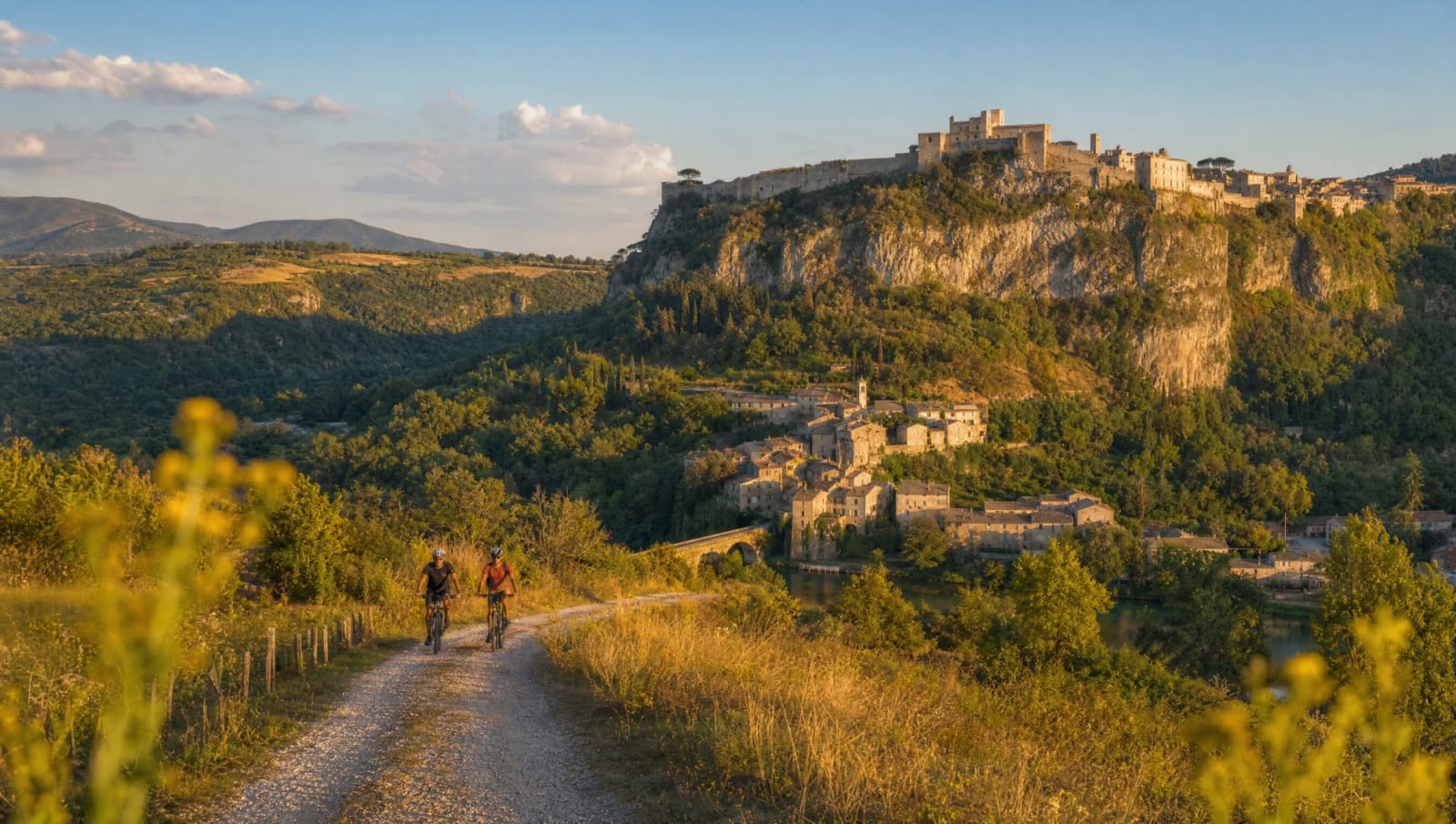
An imposing medieval fortress dominating the city of Narni. Built in the 14th century by Cardinal Albornoz, it offers an extraordinary panoramic view over the Nera valley.
Location in Umbria
Nera Gorges, Rocca Albornoziana, Stifone
About Narni and Terni
Territory shaped by the Nera river and the hills around Terni. Rich in untamed nature, medieval hill villages and unexpected views.



The points of interest you come across on the experiences available in this area, grouped by municipality.
Castello / Rocca
An imposing medieval fortress dominating the city of Narni. Built in the 14th century by Cardinal Albornoz, it offers an extraordinary panoramic view over the Nera valley.
Natura / Gola
A spectacular natural canyon carved by the Nera river through limestone rock. An ideal destination for nature lovers, offering views of rare beauty.
Natura / Gola
An ancient hill village with medieval mills overlooking the crystal-clear waters of the Nera. A corner of Umbria that has remained intact through the centuries.
Panorama
The exact point at the geographic centre of the Italian peninsula, located near Narni. A unique historical and geographical curiosity.
Chiesa / Abbazia
Romanesque Benedictine abbey set among the green Umbrian hills. One of the most evocative spots of spirituality and silence in the region.
Archeologia
A network of underground chambers beneath the historic centre: a frescoed medieval oratory, the Inquisition chamber and a Roman well. A journey through the city's layered history, from the Middle Ages to the modern era.
Archeologia
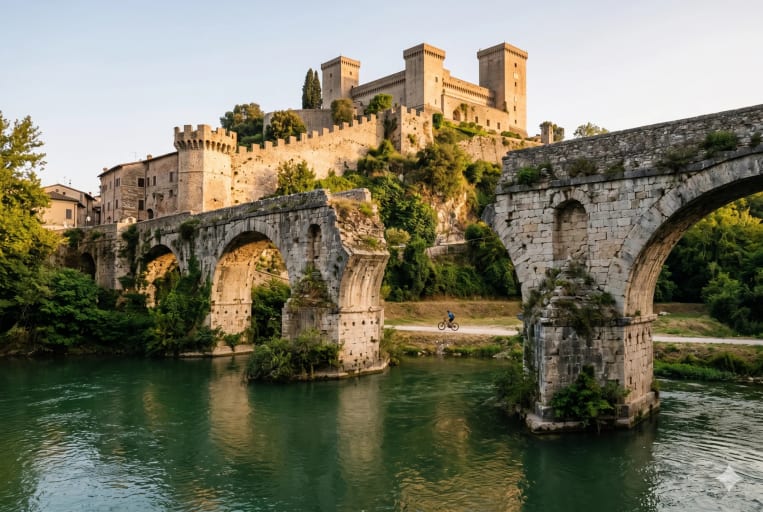
The imposing surviving arch of the Roman bridge built in 27 BC to cross the Nera. Around 30 metres high, it's one of the most evocative remains of Roman engineering in Umbria, reachable by bike along the river bank.
Natura / Gola
A large oak, Turkey oak and hornbeam wood on the hillsides around Narni. Crossed by gravel trails and cart tracks, it's the city's green lung and the main setting for local MTB experiences.
Chiesa / Abbazia
Romanesque cathedral dedicated to San Giovenale, Narni's first bishop. Built between the 6th and the 12th century, it preserves notable medieval frescoes and an intimate atmosphere in the heart of the historic centre.
Storico
Heart of the Corsa all'Anello, the most distinctive medieval re-enactment in Umbria. Each year, the knights of the three districts of Mezule, Fraporta and Santa Maria compete at full gallop to spear a 6 cm ring with their lance. The race draws inspiration from the Statuta of 1371.
Centro storico
Medieval hill village surrounded by 13th-century walls, nicknamed 'the Balcony of Umbria' for its 360-degree view stretching from the Apuan Alps to the Abruzzo Apennines. Home of the Sagrantino DOCG wine.
Enogastronomia
Historic vineyards wrapping the hills around Montefalco. The Sagrantino, a native red grape of very ancient origin, produces a tannic, long-lived wine among the most acclaimed worldwide. Riding these roads between the rows is a unique sensory experience.
Panorama
Montefalco's town tower, 26 metres high, offers central Umbria's most celebrated viewpoint: Spoleto, Foligno, Assisi, Spello and the Sibillini Mountains in the distance are all visible. An essential stop for those riding through this area.
Chiesa / Abbazia
Former 14th-century Franciscan church, now a museum hosting the cycle of frescoes by Benozzo Gozzoli dedicated to the life of St Francis. Considered one of the masterpieces of the Umbrian Renaissance, it also houses works by Perugino and Tiberio d'Assisi.
Natura / Gola
One of Europe's tallest man-made waterfalls, created by the Romans in 271 BC to channel the waters of the Velino into the Nera. With a total drop of 165 metres over three tiers, it's a natural spectacle of rare beauty set in the green Valnerina.
Altro
Cycle-pedestrian path along the Nera river connecting Terni to the Marmore Falls and continuing into the Valnerina. Natural flat gravel through riparian woods, ponds and rocky walls. One of Umbria's most accessible and spectacular routes, suitable for all levels.
Natura / Gola
A protected nature area extending along the Nera river, from its confluence with the Velino as far as Triponzo. Downy oak and Turkey oak woods, limestone cliffs and stretches of crystal-clear river: one of Umbria's most intact ecological corridors.
Lago / Fiume
A small natural lake at the foot of Monte Caperno, a few kilometres from the Marmore Falls. Still waters, a lakeside village and the historic home of Italian rowing. Perfect for a flat-road circumnavigation by bike.
Archeologia
Remains of the ancient Roman city of Otricoli, with theatre, baths and domus. One of the most evocative archaeological sites in southern Umbria.
Archeologia
Vast site of the ancient Roman city of Ocriculum, among the best preserved in southern Umbria. Theatre, amphitheatre, baths and civic basilica emerge from the surrounding countryside, reachable by bike from Otricoli.
Centro storico
A small medieval village on a hill overlooking the Tiber valley. Historic urban fabric with alleys, arches and panoramic terraces. The gateway to Umbria from the Lazio side, ideal as a start or end point for cycling routes.
Natura / Gola
Natural springs of crystal-clear waters that inspired poets and painters from Virgil to Corot. A UNESCO World Heritage site.
Archeologia
An early-Christian jewel from the 4th-5th century, designated a UNESCO World Heritage site. A small Lombard temple of rare classical elegance.
Archeologia
A Roman bridge over the Fonnaia stream, along the Via Flaminia, still perfectly preserved with its original arch. A stop largely unknown to tourists, reachable on gravel through the countryside between Narni and San Gemini. A hidden jewel of Roman engineering.
Archeologia
A stretch of the ancient Roman consular road that crossed the Martani Mountains, connecting Rome with Rimini. In some sections the original Roman paving is still visible. Riding this road is a direct immersion in ancient history, across unchanged rural landscapes.
Centro storico
An ancient medieval hill village perched on a rocky spur in the Valley of Spoleto, among olive groves and cypresses. Famous for producing some of Italy's finest DOP extra-virgin olive oil, it offers a historic centre of arches, fountains and a civic tower with views over the plain.
Enogastronomia
The olive groves surrounding Trevi produce an outstanding DOP extra-virgin olive oil, with an intense fruity profile and a distinctive peppery finish. Riding among the rows of olive trees in autumn, during the harvest, is one of Umbria's most authentic sensory experiences.
Naturalistico
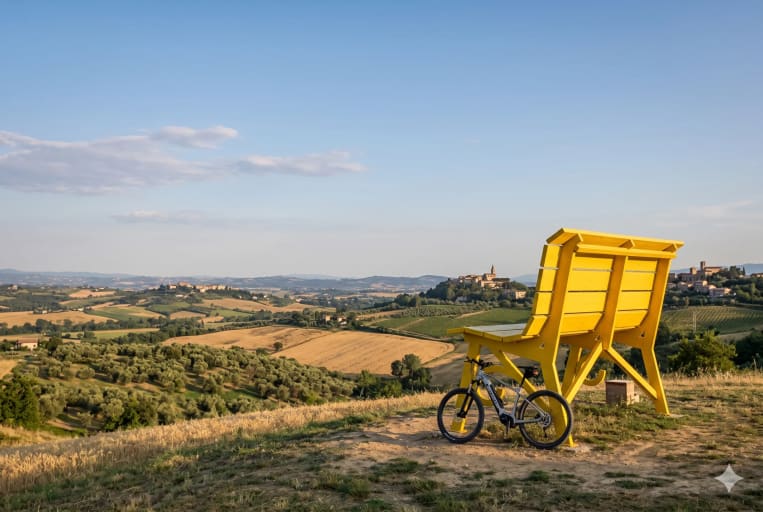
Giant Bench No. 343 on the edge of the ancient Via Amerina, today the Way of Light. Reached from Farnetta along 21 km of countryside and woodland. The setting evokes the most authentic, off-the-beaten-track Umbria.
Naturalistico
Giant Bench No. 345 in the medieval village of Casteltodino, the last stop on the loop before returning to Montecastrilli. A hilltop village overlooking the Tiber valley. The bench closes the circuit of the town's six Big Benches.
Naturalistico
Giant Bench No. 342 at Collesecco, reachable through Casteltodino across open countryside and ancient castles. Stop on the Quadrelli–Collesecco segment (9 km), with lovely views over the hills towards the Tiber.
Naturalistico
Giant Bench No. 346 set in the rural landscape of Farnetta, reachable through the atmospheric Frainetto Wood. First stop on the Big Bench Route loop, 9 km from the Montecastrilli information point. Views over the hills and Farnetta castle.
Naturalistico
Giant Bench No. 341 of the Big Bench Community Project, set above the town of Montecastrilli overlooking what was once the Tiberino Lake, with a view of the castle destroyed by the condottiero John Hawkwood. One of the most panoramic on the entire loop.
Naturalistico
A natural basin at the end of the Nera Gorges. Crystal-clear spring water in emerald tones, with a sunbathing area and picnic spot right by the river. The ideal end-point for a refreshing break after descending from the historic centre.
Naturalistico
Giant Bench No. 344 near the medieval castle of Quadrelli. An easy stop (11 km from Montecastrilli) with minimal elevation gain, set among the vineyards and olive groves of the Terni basin. Open view over the surrounding hills.
Archeologia
Archaeological site of one of Umbria's most intact Roman cities, abandoned after the 5th-century earthquake and never rebuilt. The forum, theatre, amphitheatre and a paved stretch of the Via Flaminia emerge from the ground. Set in a quiet green park, reachable by bike from Terni.
Centro storico
Medieval hill village in the heart of the Umbrian Valley, with still-intact Roman walls, flower-decked arches and alleys filled with geraniums. Famous for the Calendimaggio festival and for the basilica of Santa Maria Maggiore with frescoes by Pinturicchio.
Borgo
A small hill village on the banks of the Nera river with about 40 residents, famous for its crystal-clear waters shifting from emerald green to deep blue. Here lie the remains of Narni's ancient Roman port.